Their life helped.

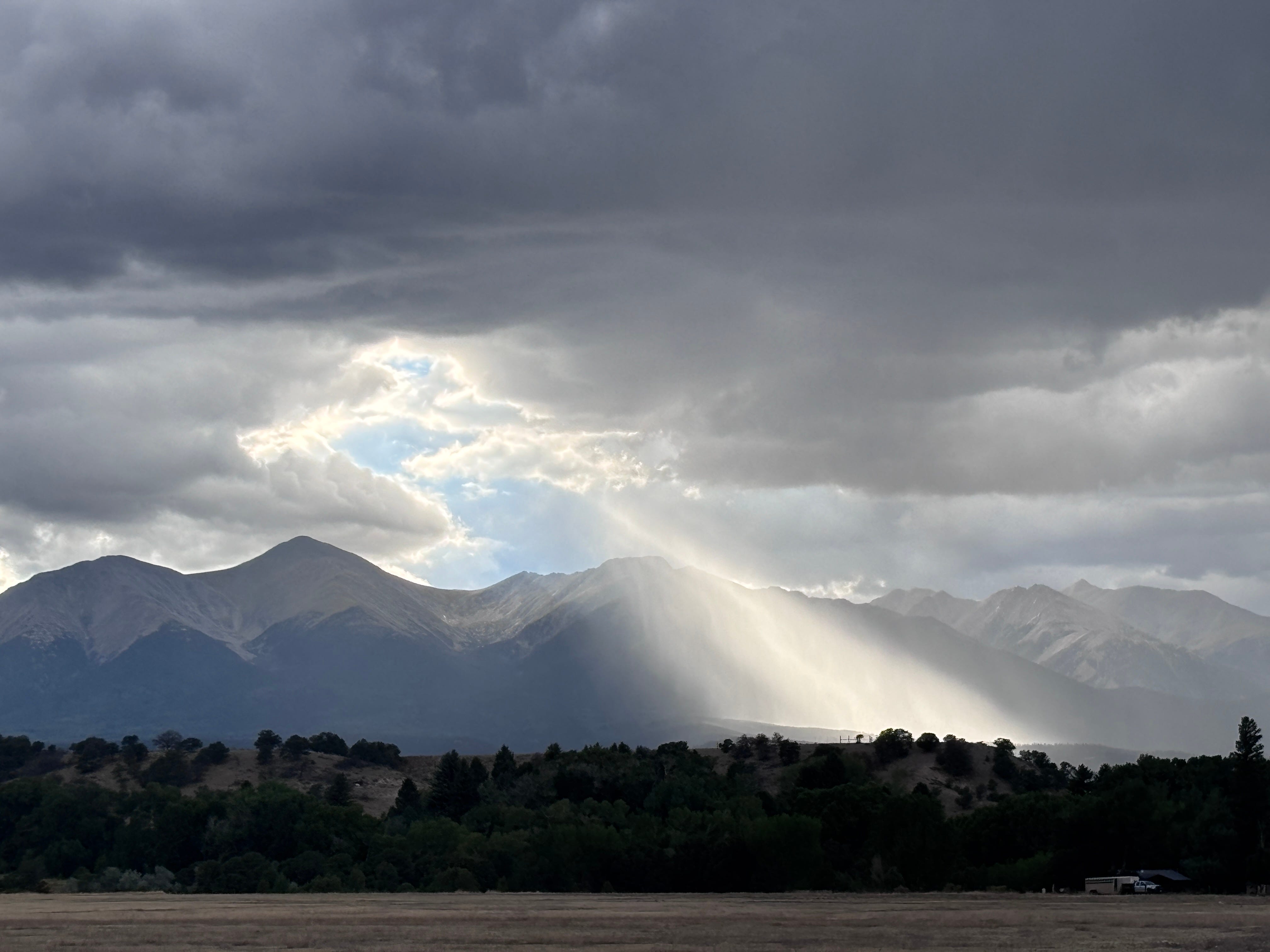
Last week, the monsoon rains finally arrived in southern Colorado. Or at least, the beginning of what we hope will be a monsoonal pattern. It was our first major rain event in more than a year. Great sheets of water lashing the windows. Immediate canyons carved in the hydrophobic soils that rejected the desperately needed moisture. I sat next to the open window breathing in the petrichor, the tremendous exhale of our parched landscape. The high desert is a patient environment. To survive, plants and animals must hold their reserves close, waiting for the recharge. But as we are all experiencing now, those periods in between extreme swings are becoming longer. I find myself asking when the patience will run out.
Over the course of a lifetime of being at the mercy of writing, one of the lessons that I’ve learned is that it also requires patience. Push too hard when my brain isn’t engaged and progress screeches to a halt. Instead of getting frustrated when I reach that point, I pull out my toolbox. My creativity fix-it kit. For me, that means recharging through other creative pursuits, reading words by people I admire, and being in nature.
Back in June Rob Macfarlane visited Barry Lopez’s home in Oregon and shared some photos of his experience on Instagram. The image that I’ve continued to mull over is Barry’s memorial stone inscribed with his name, the dates of his life, and one sentence: His life helped.
His life helped.
After weeks of thinking about his epitaph, I pulled Barry’s last book of essays off my shelf. I had forgotten that several feature people who we had in common. Nels (Richard Nelson), one of my mentors. Bob Stephenson, who I also worked with in graduate school on his wood bison reintroduction project. As well as places in Alaska that are near to my heart.
When people ask me about my background in biology, I usually just say that I’m a botanist, because it is easy to understand. But the truth is I’m one of a vanishing breed of scientists that studied before the field of biology moved toward models, genetics, and research in tandem with technology. Naturalists. Writers like Barry Lopez, Richard Nelson, and Rick Bass were producing books during my college years that fundamentally shifted how we wrote and thought about our studies of the natural world. By the time I entered graduate school, naturalists were already a rarity. I gravitated toward the new discipline of ethnobotany, which I could explore within the anthropology department. It was the closest I could get to approaching my research from a naturalists’ perspective. Working with humans instead of plants or animals still took many of the same skills, and above all, patience. Each moment needs to be approach as an invitation. Either you meet it as it has been offered, or the opportunity passes.
Isn’t it an adage that longer you live, the more you see that life is a spiral? (Totally possible that I made that up.) But as we go deeper into the climate crisis, I see more people leaning on the fundamentals we learned as naturalists. Lopez describes them in his book as:
To pay attention is an act of devotion, an act of service. And it is an exchange. A hot summer means more grasshoppers. Birds choosing to nest closer to water. How does our behavior in those conditions also change and how does that impact the living things around us?
For too long the equation has been unbalanced. Humans taking and taking without acknowledging the absence left behind. Is it too late to correct the damage? Honestly? Probably. But that doesn’t mean that we can’t follow Lopez’s example.
His life helped.
As we’ve been slowly landscaping our backyard, we’ve chosen drought tolerant native plants, but even those have struggled under the brutal conditions. We are in stage 2 water restrictions, which means we water every other day. This morning, I went out at 7:00 am to give our mulched beds a drink. It always takes me awhile because I check each of the plants. To judge who needs water, whether or not I want them to put their productivity into seeding (almost always yes with natives), which plants need extra attention. I try not to play favorites, but I always stop to smell the chocolate flower (Berlanderia lyrata) and run my hand along the sage. In our second summer, it remains a negotiation between me and the land. My transplanted piñon pines did not survive. But the windblown scarlet globe mallow and yarrow continue to fill in the bare areas. While I water, the neighborhood birds come into the flit around our bit of habitat. I’m not saving acres of endangered sagelands or reforesting cleared mountainsides. But in this small corner, my actions make a difference. I try to carry that mindset as I resume my place in front of the keyboard.
Pay attention. Be patient.
Such a beautiful piece, Amy.
I've always loved that old adage. I think it was popularized by Carl Jung, though its origin is in antiquity. "The path isn't a straight line; it's a spiral. You continually come back to things you thought you understood and see deeper truths." Thanks for reminding us of the many beautiful sights, ideas and people we might encounter on our own spiral journeys, Amy!